The medical reality of anabolic steroid use is that side effects are not merely a possibility; they are a physiological certainty. When you introduce supraphysiological levels of hormones into the body, you disrupt homeostatic balance.
While complete safety is impossible with non-medical use, harm reduction protocols can significantly mitigate specific risks. This guide focuses on the “Big Three” areas of concern: Cardiovascular health, Liver toxicity, and Hormonal suppression.
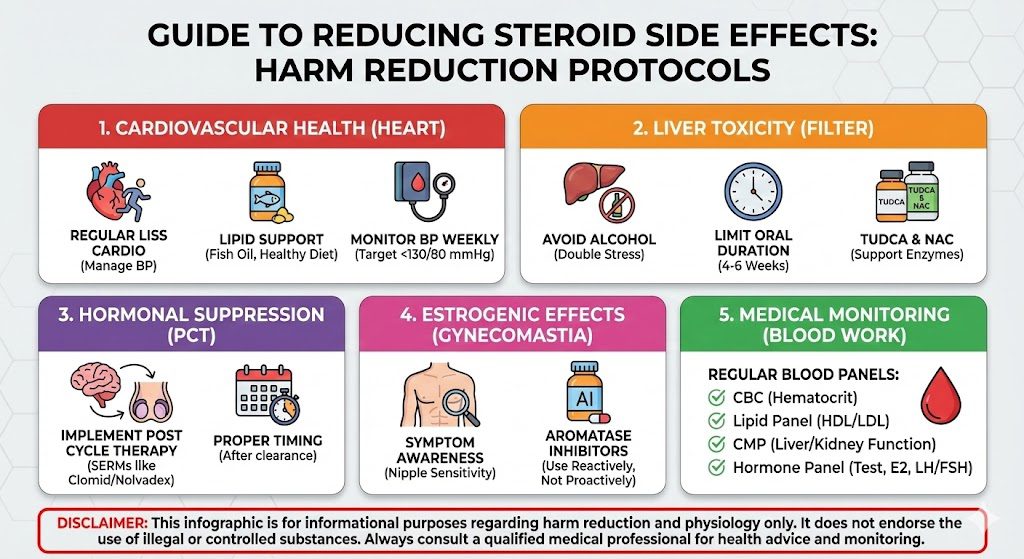
1. Cardiovascular Health: The Silent Killer
Cardiovascular strain is the leading cause of premature mortality in steroid users. AAS use can cause left ventricular hypertrophy (thickening of the heart), hypertension, and dyslipidemia (poor cholesterol levels).
Management Strategies
- Cardio is Non-Negotiable: Regular low-intensity steady-state (LISS) cardio is essential to manage blood pressure and offset the arterial stiffening caused by androgens.
- Lipid Management: Steroids—especially oral variants—drastically lower HDL (“good” cholesterol) and raise LDL (“bad” cholesterol). To combat this:
- Supplement with high-dose Fish Oil (3–4g daily) to support lipid profiles.
- Minimize saturated fats and increase fiber intake.
- Blood Pressure Monitoring: High blood pressure (hypertension) is a “silent killer” because it often has no symptoms until damage is done. Users should own a home blood pressure cuff and monitor weekly. If readings consistently exceed 130/80 mmHg, medical intervention may be necessary.
2. Liver Toxicity: Protecting the Filter
Oral steroids (like Dianabol or Anadrol) are C-17 alpha-alkylated, a chemical modification that allows them to survive digestion but makes them highly hepatotoxic (toxic to the liver).
Harm Reduction Protocols
- Avoid Alcohol: Combining alcohol with oral steroids places a “double stress” on the liver that can accelerate damage.
- Cycle Duration: Oral compounds are typically limited to short durations (e.g., 4–6 weeks) to allow liver enzymes to normalize.
- Liver Support Supplements:
- TUDCA (Tauroursodeoxycholic Acid): Clinically shown to improve bile flow and reduce liver enzymes. It is considered the gold standard for on-cycle liver support.
- NAC (N-Acetyl Cysteine): A precursor to glutathione, the body’s master antioxidant, which helps protect the liver from oxidative stress.
3. Hormonal Suppression and PCT
All anabolic steroids suppress the body’s natural production of testosterone. Once a cycle ends, the body is left in a hypogonadal state (low testosterone), which can lead to muscle loss, depression, and sexual dysfunction.
The Role of Post Cycle Therapy (PCT)
“PCT” refers to a protocol of medication used to restart natural hormone production.
- SERMs (Selective Estrogen Receptor Modulators): Drugs like Clomiphene (Clomid) or Tamoxifen (Nolvadex) are used to stimulate the pituitary gland to release LH and FSH, signaling the testes to produce testosterone again.
- Timing: PCT must begin only after the exogenous steroids have cleared the system. Starting too early renders the therapy ineffective.
4. Estrogenic Side Effects: Gynecomastia
Many steroids convert into estrogen (aromatize). Excess estrogen can lead to gynecomastia—the development of breast tissue in men.
Control Mechanisms
- Aromatase Inhibitors (AIs): Medications like Anastrozole block the conversion of testosterone to estrogen. However, crashing estrogen too low is dangerous, as estrogen is neuroprotective and vital for joint health and libido. AIs are typically used reactively (only when symptoms appear) rather than proactively.
- Symptom Awareness: Early signs include sensitivity or “spiciness” in the nipples. Ignoring these signs can lead to permanent tissue growth that requires surgery.

5. Medical Monitoring
The single most effective way to reduce side effects is regular blood work. Guessing based on “how you feel” is dangerous because parameters like cholesterol, liver enzymes, and hematocrit (blood thickness) can be critically dangerous without physical symptoms.
Essential Blood Markers to Watch:
- CBC (Complete Blood Count): Specifically Hematocrit. If blood becomes too thick, the risk of stroke increases.
- Lipid Panel: HDL/LDL ratios.
- CMP (Comprehensive Metabolic Panel): Kidney (eGFR) and Liver (ALT/AST) function.
- Hormone Panel: Total Testosterone, Free Testosterone, Estradiol (E2), LH, and FSH.
Conclusion
Reducing steroid side effects is not about “tricking” the body; it is about damage control. By prioritizing cardiovascular health, using targeted organ support like TUDCA, and adhering to strict PCT protocols, users can mitigate—but never fully eliminate—the risks associated with AAS use.