


In the modern era of performance enhancement, the conversation has shifted. The days of “more is better”—characterized by the mass monsters of the 90s and aggressive megadosing—are increasingly being replaced by the biohacker’s philosophy: “minimum effective dose.” This shift has popularized the concept of microdosing across various substances, from psychedelics to nootropics. Naturally, this trend has bled into the world of anabolic-androgenic steroids (AAS).
The question “Can you microdose steroids?” is common among fitness enthusiasts seeking a slight edge without the aggressive side effects of a full “blast.” However, the answer is complex. Unlike microdosing psilocybin, where the goal is a sub-perceptual effect, microdosing hormones interacts with a rigid biological feedback loop that changes the rules of the game.
This article explores the physiological reality of low-dose steroid use, distinguishing between effective hormone management and biological counter-productivity.
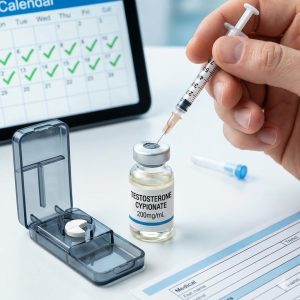
To understand if you can microdose steroids, we must first define what that means in an endocrinological context.
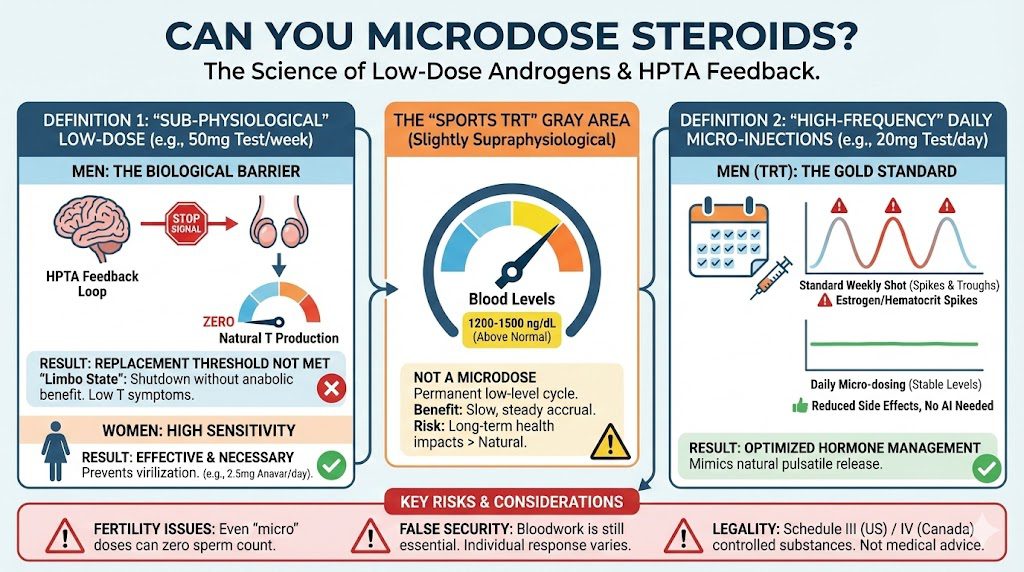
In the world of psychedelics, a microdose is typically 1/10th of a recreational dose—enough to stimulate neural pathways without causing hallucinations. In the world of anabolic steroids, the term is used loosely to describe two very different protocols:
The efficacy of “microdosing” depends entirely on which of these two definitions you are applying and whether you are male or female.
The primary argument against “microdosing” steroids (in the sense of taking tiny total amounts) is the Hypothalamic-Pituitary-Testicular Axis (HPTA).
The male body produces testosterone naturally—typically between 3mg and 10mg per day, depending on genetics and age. This production is regulated by a negative feedback loop. When your brain detects any exogenous (external) androgen in the bloodstream, it signals the testes to stop producing natural testosterone.
This creates a “threshold problem.” If a man decides to “microdose” testosterone by taking 50mg per week (approx. 7mg per day), he is essentially shutting down his natural production of ~7mg/day to replace it with… 7mg/day of synthetic testosterone.
In this scenario, the user gains zero anabolic advantage. In fact, due to the weight of the ester (the chemical attached to the testosterone), 50mg of synthetic testosterone might yield less active hormone than his body was producing naturally. The result is “chemical castration” without the benefits: shut down natural production, potential testicular atrophy, and no performance enhancement to show for it.
The Verdict: For men, you cannot “microdose” steroids in the sub-physiological sense. You must at least meet your body’s natural requirements (replacement) before you see any benefit.
While taking tiny amounts is often futile for men, frequency microdosing is a highly effective, scientifically supported protocol. This involves taking a standard TRT (Testosterone Replacement Therapy) or “Sports TRT” dose and dividing it into daily subcutaneous administrations using an insulin needle.
Why Microdose Frequency? Standard protocols might call for one large 200mg injection per week. This causes a massive spike in hormone levels within 24 hours (supraphysiological), followed by a steady decline to low levels (sub-physiological) by day 7.
By microdosing that same 200mg into roughly 28mg per day:
In this context, “microdosing” is not about taking less drug; it is about taking the drug smarter.
While microdosing is biologically tricky for men due to the replacement threshold, it is the standard and safest method for female athletes.
Women are incredibly sensitive to androgens. A dose that would do nothing for a man can completely transform a female physique. For women, “microdosing” is not a hack; it is a necessity to avoid virilization (development of male characteristics like voice deepening and hair growth).
For women, the line between “microdosing” and a “full cycle” is often just a few milligrams.
Another form of microdosing popular in the biohacking community involves the use of short-acting oral steroids or nootropic-like androgens solely on training days.
1. Dianabol or Anadrol: Some powerlifters “microdose” 10mg of Dianabol only on heavy squat days (pre-workout).
2. Proviron (Mesterolone): Proviron is unique. It is an oral androgen that doesn’t suppress testosterone as heavily as others. Some men “microdose” 25mg/day to lower SHBG (Sex Hormone Binding Globulin), thereby “freeing up” their natural testosterone to be more effective. This is one of the few instances where adding a small amount of an exogenous compound can enhance the body’s natural state without fully replacing it.
A major confusion in the “microdosing” discussion is the concept of “Sports TRT.”
Many athletes claim they are “microdosing” when they are actually running “Sports TRT.” They maintain slightly supraphysiological levels year-round. The Benefit: This approach allows for slow, steady muscle accrual that is easier to keep long-term compared to the “blow up and deflate” cycle of traditional blasting. The Risk: Even though the dose is low, you are essentially on a permanent cycle. The long-term risks to cholesterol, heart health, and prostate health are lower than a blast, but higher than being natural.
If you decide to experiment with low-dose AAS, you must understand the specific risks involved. It is not necessarily “safer” just because the dose is low.
1. The “Limbo” State: Taking a dose that is too low can leave you with testosterone levels lower than when you started.
2. Fertility Issues: Even small doses of exogenous testosterone can reduce sperm count to zero.
3. False Security: Users may skip blood work because “it’s only a small dose,” even though individual responses vary widely.
Can you microdose steroids?
Ultimately, the concept of microdosing steroids is often a rebranding of Testosterone Replacement Therapy. For the healthy natural male with optimized hormones, introducing “micro” amounts of steroids offers a high risk of shutdown for a negligible reward. The most effective “microdose” for the average gym-goer remains a dialed-in diet, optimized sleep, and targeted supplementation like Creatine and Vitamin D.