


In the spheres of high-performance athletics, advanced bodybuilding, and regenerative medicine, the ultimate bottleneck has never been training intensity; it has always been tissue recovery. Anabolic steroids can push muscle hypertrophy beyond genetic limitations, but they often leave tendons, ligaments, and joints struggling to support the new, rapid force generation. This discrepancy leads to catastrophic tears, chronic tendinopathy, and systemic inflammation.
Enter the world of therapeutic peptides.
Moving away from the brute-force biological manipulation of traditional anabolics, peptides like BPC-157 (Body Protection Compound) and TB-500 (Thymosin Beta-4) act as precise biological messengers. They do not force the body to grow; they signal the body to heal. When run concurrently, this combination is colloquially known as the “Wolverine Stack” due to its profound capacity to accelerate the repair of muscle, tendon, ligament, and bone tissue.
This guide provides a strictly informational breakdown of the biological mechanisms, synergistic effects, reconstitution math, and standard community protocols for combining BPC-157 and TB-500.
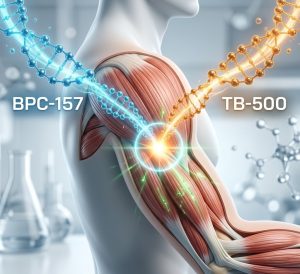
To understand why these two compounds are combined, you must first understand how they operate individually. They achieve the same ultimate goal (tissue repair) through entirely different, non-competing biological pathways.
BPC-157 is a synthetic, 15-amino-acid sequence derived from a naturally occurring protective protein found in human gastric juice. In the stomach, its primary role is to heal ulcers and protect the endothelial lining from damage. However, when synthesized and injected, its healing properties extend to nearly every tissue in the body.
TB-500 is a synthetic version of Thymosin Beta-4, a naturally occurring peptide present in almost all human and animal cells, highly concentrated in blood platelets and wound fluid.
Running BPC-157 or TB-500 individually yields impressive results, but combining them creates a biological synergy that exponentially accelerates the healing timeline.
The easiest way to conceptualize this synergy is to view the injury site as a massive construction project:
Furthermore, because BPC-157 is largely localized and TB-500 is entirely systemic, the user is attacking the injury from two different angles. BPC acts as a targeted strike on the specific tear, while TB-500 lowers total-body inflammation and addresses micro-tears the user might not even be fully aware of yet.
Peptides are not sold in liquid form; they are highly fragile chains of amino acids. To survive shipping and prevent rapid degradation, they are lyophilized (freeze-dried) into a solid puck of white powder at the bottom of a glass vial. Before they can be administered, they must be reconstituted.
1. The Diluent: Bacteriostatic Water (BAC) Peptides must be reconstituted exclusively with Bacteriostatic Water. BAC water is sterile water containing 0.9% Benzyl Alcohol. The alcohol prevents the growth of bacteria, allowing the reconstituted peptide vial to remain sterile and safe to inject for approximately 28 to 30 days when refrigerated. Using plain sterile water means the vial will become a breeding ground for bacteria within 48 hours.
2. The Fragility of Peptide Bonds Amino acid bonds are incredibly delicate. Rough handling, violent shaking, or aggressive reconstitution can shear the bonds, destroying the compound before it ever enters your body.
3. The Reconstitution Math Understanding how to dose requires basic division. You are dissolving a massive amount of micrograms (mcg) into a small amount of milliliters (mL).
Example using a standard 5mg vial of BPC-157:
Because these are research chemicals, there is no FDA-approved dosing guideline. The protocols below reflect the established consensus among performance enhancement researchers, longevity clinics, and elite athletes.
Because BPC-157 has a relatively short half-life (roughly 4 to 6 hours), it must be administered frequently to maintain elevated serum levels for continuous healing.
TB-500 has a much longer active life in the body, meaning daily injections are entirely unnecessary. It is typically front-loaded to build up blood serum levels, followed by a maintenance phase.
Tissue repair is a biologically demanding process that cannot be instantly resolved, even with advanced chemical signaling.
While the healing properties of these peptides are profound, they are bound by the laws of physics and biology.
1. They Are Not Surgical Replacements If an athlete completely ruptures a tendon (where the tendon separates entirely from the bone), BPC-157 and TB-500 cannot magically reattach it. Complete ruptures require surgical intervention. However, utilizing the Wolverine Stack post-surgery can cut the rehabilitation and recovery timeline in half and result in a vastly stronger structural repair.
2. Side Effects and Tolerability Compared to anabolic steroids or harsh anti-inflammatory drugs (NSAIDs) which destroy the stomach lining and tax the liver, peptides are exceptionally well-tolerated.
3. The Importance of Sourcing The peptide market is notoriously under-regulated. Because a vial of 5mg of BPC-157 looks identical to a vial of 5mg of baking soda, inferior black-market labs frequently underdose their products or sell degraded, improperly synthesized amino acid chains. Utilizing impure peptides can lead to severe site infections, systemic immune responses, and zero therapeutic benefit. Always ensure your research chemicals are sourced from facilities that provide verifiable, third-party lab testing.
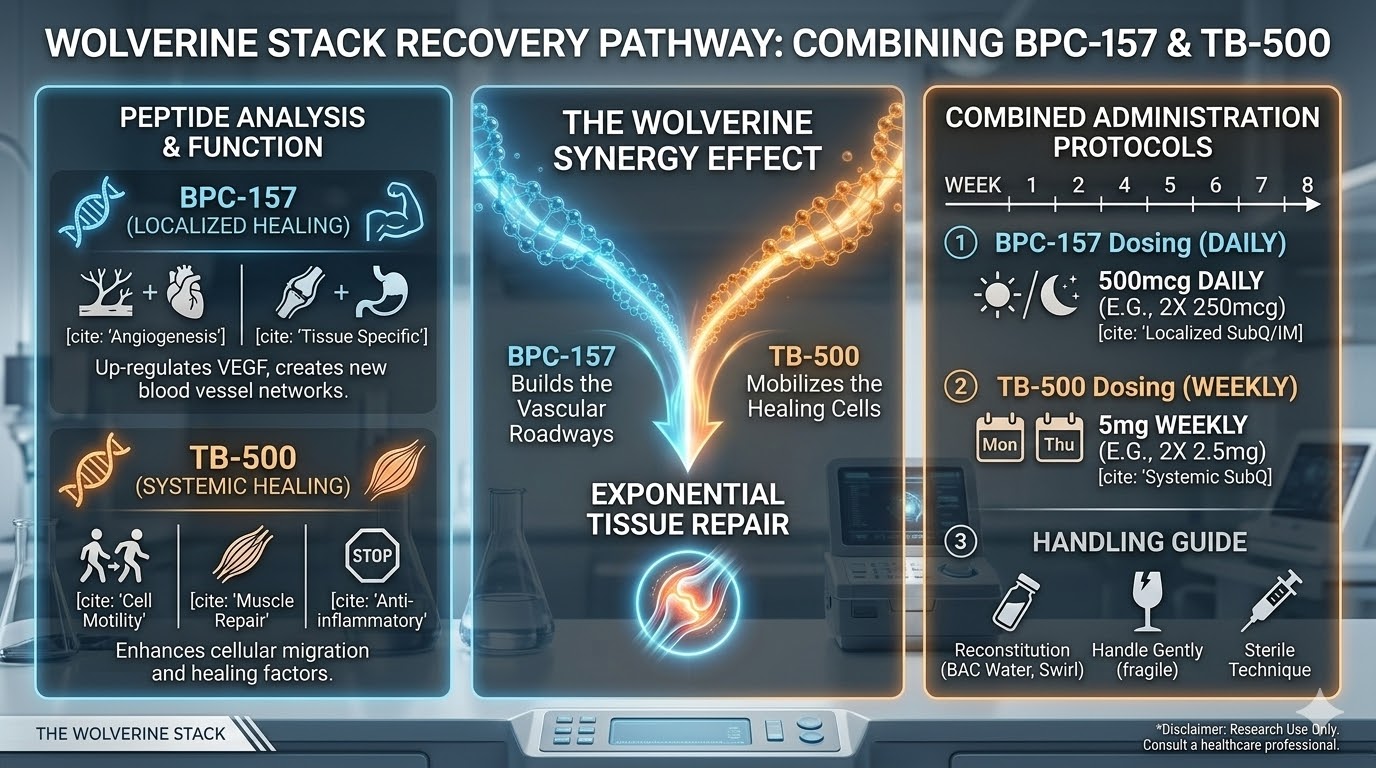
The integration of BPC-157 and TB-500 represents a paradigm shift in sports medicine and performance recovery. By understanding the distinct mechanisms—BPC-157 driving the localized vascular infrastructure and TB-500 mobilizing the systemic cellular workers—researchers can systematically dismantle the barriers of chronic pain and injury.
When properly reconstituted, accurately dosed, and combined over a rigid 4-to-8-week protocol, the Wolverine Stack provides the biological signaling required to heal the unhealable, allowing athletes to return to baseline faster, stronger, and more resilient than before.