

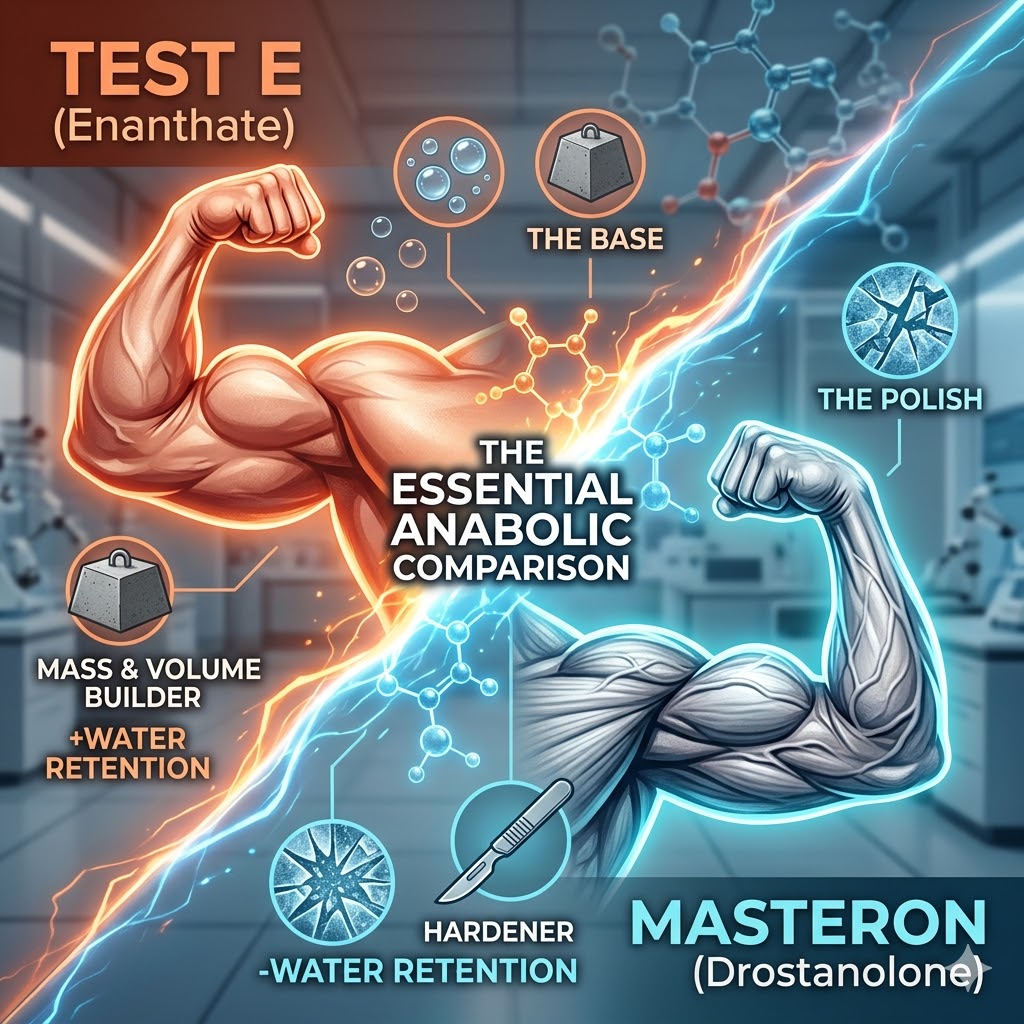
In the advanced study of sports pharmacology, compounds are rarely judged in isolation. They are evaluated based on their specific physiological roles, their mechanisms of action, and how they interact with the human endocrine system. When researchers and performance athletes discuss “Test E” (Testosterone Enanthate) and “Masteron” (Drostanolone), they are not looking at two interchangeable drugs. They are looking at two fundamentally different tools that serve entirely different structural purposes.
To compare Testosterone Enanthate against Masteron is to compare the concrete foundation of a building against the final aesthetic polish applied to its exterior. One provides the biological baseline required for mass and function; the other refines that mass, stripping away water and amplifying the cosmetic appearance of the muscle.
This comprehensive guide breaks down the independent mechanics of both Testosterone Enanthate and Masteron, their direct comparisons, and the profound biochemical synergy that occurs when these two compounds are utilized together.
Before any secondary anabolic compound can be introduced, a physiological baseline must be established. This is the role of Testosterone Enanthate.
Testosterone is the primary male androgen, responsible for the development of male physical characteristics, muscle hypertrophy, bone density, and neurological drive. In its raw, unesterified form, exogenous testosterone has an incredibly short half-life and would require multiple injections per day to maintain stable blood serum levels.
To solve this, the testosterone molecule is attached to an Enanthate ester. This ester is a lipid (fat) chain that slows the release of the hormone into the bloodstream. Once injected, enzymes in the body slowly cleave off the Enanthate ester, releasing the active testosterone. Testosterone Enanthate carries a half-life of approximately 4.5 to 5 days, making it ideal for stable, long-term cycles ranging from 12 to 16 weeks, typically requiring injections twice per week.
Testosterone is the ultimate biological signaling molecule for growth. When introduced at supraphysiological doses, it binds directly to the androgen receptors within muscle tissue, triggering a cascade of anabolic processes:
Nitrogen Retention: It forces the muscles to hold more nitrogen, creating a positive nitrogen balance that is essential for synthesizing new muscle proteins.
IGF-1 Production: It signals the liver and muscle tissues to drastically increase the production of Insulin-like Growth Factor 1 (IGF-1), a highly anabolic hormone that drives cellular hyperplasia (the creation of new muscle cells).
Red Blood Cell Count: It stimulates the kidneys to release erythropoietin (EPO), increasing red blood cell production for greater muscular endurance and oxygen delivery.
Crucially, Testosterone is a “wet” compound. It heavily interacts with the aromatase enzyme, which converts a portion of the circulating testosterone into Estradiol (Estrogen). While high estrogen can cause side effects, a moderate amount of estrogen is highly anabolic. It increases glucose utilization, protects joints by increasing synovial fluid, and drives intracellular water into the muscles, resulting in massive strength gains and rapid tissue accumulation.
If Testosterone is the raw material, Masteron is the precision scalpel used to carve out the final aesthetic.
Masteron (chemical name Drostanolone) was originally synthesized in 1959 and later utilized as a highly effective treatment for inoperable breast cancer in postmenopausal women. Its medical application was rooted in its unique ability to lower estrogen levels and halt the growth of estrogen-dependent tumors.
In performance enhancement, Masteron is classified as a strict “dry” compound and a cosmetic finisher. It does not build massive amounts of raw tissue like Testosterone or Dianabol. Instead, it alters the visual density of the muscle that already exists.
To understand Masteron, you must look at its molecular structure. Drostanolone is a derivative of Dihydrotestosterone (DHT). It has been chemically altered with the addition of a 2-alpha-methyl group. This seemingly small structural change does two critical things:
Protects against breakdown: It prevents the compound from being instantly destroyed by the 3-alpha hydroxysteroid dehydrogenase enzyme found in skeletal muscle, allowing it to remain highly active.
Prevents aromatization: Because it is derived from DHT, it inherently lacks the chemical structure required to interact with the aromatase enzyme. Masteron cannot convert into estrogen.
Because it does not aromatize, Masteron causes zero water retention. It pulls subcutaneous fluid out from under the skin, leaving the muscles looking incredibly dense, hard, and heavily vascular.
When evaluating these two compounds side-by-side, their differences in application become starkly apparent.
Testosterone Enanthate is the Base: No cycle should ever be run without a testosterone base. Exogenous androgens shut down the body’s natural production of testosterone. Running any steroid without a testosterone base will result in lethargy, sexual dysfunction, and severe physiological crash.
Masteron is the Addition: Masteron is never run alone. Running a DHT derivative by itself would crush natural testosterone production, crash estrogen levels, and lead to miserable side effects. Masteron is an ancillary compound explicitly designed to be stacked on top of a testosterone base.
Testosterone possesses an anabolic-to-androgenic ratio of 100:100. It builds muscle efficiently but also carries significant androgenic traits.
Masteron possesses a ratio of roughly 62:25. It has a relatively low anabolic rating, which is why it is not used to build massive size. However, it is highly androgenic in its binding affinity, which leads to intense central nervous system (CNS) stimulation, increased aggression in training, and immense strength output relative to body weight.
Because they operate through different pathways, their side effect profiles are entirely distinct.
Testosterone Risks: Driven by aromatization. The primary side effects are estrogenic—gynecomastia (male breast tissue growth), severe water retention, elevated blood pressure from the water weight, and potential acne.
Masteron Risks: Driven by its DHT nature. Masteron is notorious for causing highly androgenic side effects in individuals prone to them. This includes accelerated male pattern baldness (alopecia), prostate enlargement, and increased aggression. Crucially, anti-hair-loss drugs like Finasteride are entirely useless against Masteron, because Finasteride stops the conversion of testosterone to DHT. Masteron is already a DHT derivative; the conversion has already happened.
The true value of analyzing Test E and Masteron comes from understanding what happens when they are combined. The “Test/Mast” stack is considered one of the most mechanically perfect combinations in performance pharmacology.
When these two compounds are introduced simultaneously, Masteron chemically alters how the body processes the Testosterone Enanthate. It acts as an amplifier.
Sex Hormone-Binding Globulin (SHBG) is a protein produced in the liver. Its job is to bind to sex hormones (like testosterone) floating in the blood, rendering them inactive. In a normal human male, roughly 98% of all testosterone is bound by SHBG and albumin. Only the remaining 2% is “Free Testosterone”—the active hormone that can actually enter the muscle cells and trigger growth.
Masteron has a remarkably high binding affinity for SHBG. When introduced into the bloodstream, the Masteron molecules aggressively attach themselves to the SHBG proteins. Because the SHBG is entirely occupied by the Masteron, it can no longer bind to the Testosterone.
The result? The amount of “Free” (active) Testosterone from the Test E injection skyrockets. The Masteron effectively unlocks the Testosterone, multiplying its anabolic potential without requiring the user to increase the actual dosage of the Test E.
As discussed, Testosterone Enanthate aromatizes into estrogen, which often requires the user to take a secondary drug—an Aromatase Inhibitor (AI) like Aromasin or Arimidex—to prevent gynecomastia and water bloat.
However, Masteron possesses unique, inherent anti-estrogenic properties. While it is not a true suicide inhibitor like Aromasin, it acts similarly to a SERM (Selective Estrogen Receptor Modulator) in the breast tissue, and it has a mild inhibitory effect on the aromatase enzyme itself.
By stacking Masteron with Test E, the user can often run much higher doses of Testosterone without needing a harsh, chemical AI. The Masteron keeps the estrogenic side effects in check, preventing the water bloat from the Test E and ensuring the resulting muscle gains are clean, dry, and highly aesthetic.
When deploying these compounds, the ester timeline and the athlete’s body fat percentage dictate the protocol.
Because Testosterone Enanthate utilizes a long, slow-acting ester, it is optimal to pair it with Masteron Enanthate (Mast E). This ensures that both hormones release into the bloodstream at the exact same rate. The user can draw both compounds into the same syringe and inject them simultaneously on a simple twice-per-week schedule (e.g., Monday and Thursday), keeping blood serum levels perfectly stable.
Standard Ratio: Researchers often utilize a 1:1 or 2:1 ratio. A common protocol might look like 400mg of Test E alongside 400mg of Mast E per week.
While Testosterone works efficiently at any body fat level to build mass, Masteron is entirely dependent on the user’s conditioning. Because Masteron is a cosmetic finisher, its effects are invisible if the user is covered by a thick layer of adipose tissue.
Deploying Masteron when a user is above 12% to 15% body fat is a waste of the compound. The DHT derivative will harden the muscle underneath, but the visual “dry, granular” look will be hidden by the fat. Masteron shines exclusively when the user is already exceptionally lean, serving to pull out the final layer of subcutaneous water to reveal deep muscle striations and extreme vascularity.
Testosterone Enanthate and Masteron are not opposing forces; they are the two halves of a highly refined physiological equation.
Testosterone Enanthate provides the raw, unavoidable biological foundation. It serves as the primary driver of nitrogen retention, neurological output, and overall muscular hypertrophy. It is the heavy machinery required to build the structure.
Masteron serves as the specialized architect. Devoid of estrogenic conversion, it functions not to build new mass, but to dramatically amplify the efficiency of the testosterone baseline by binding to SHBG. It simultaneously acts as a biological shield, mitigating the estrogenic fallout of the testosterone base while stripping away extracellular water to yield a dense, clinically hardened aesthetic.