


In the quest to overcome the slow biological limitations of tendon repair, many pullers have turned to the “Wolverine Stack”: BPC-157 and TB-500. These two peptides have become staples in the community, promising to turn months of rehab into weeks of recovery.
This article explores the science behind these compounds, specifically tailored to the unique physiological demands of armwrestling.
The Physiology of the “Pull”: Why Armwrestlers Break
To understand why these peptides are so highly valued, we must first understand the structural failure points of an armwrestler.
In a hook or a toproll, the primary stress is not on the belly of the bicep, but on the musculotendinous junction (where muscle meets tendon) and the enthesis (where tendon meets bone).
- Side Pressure: Places immense strain on the Medial Collateral Ligament (MCL) of the elbow and the humerus bone itself.
- Back Pressure: Loads the distal bicep tendon and the brachioradialis.
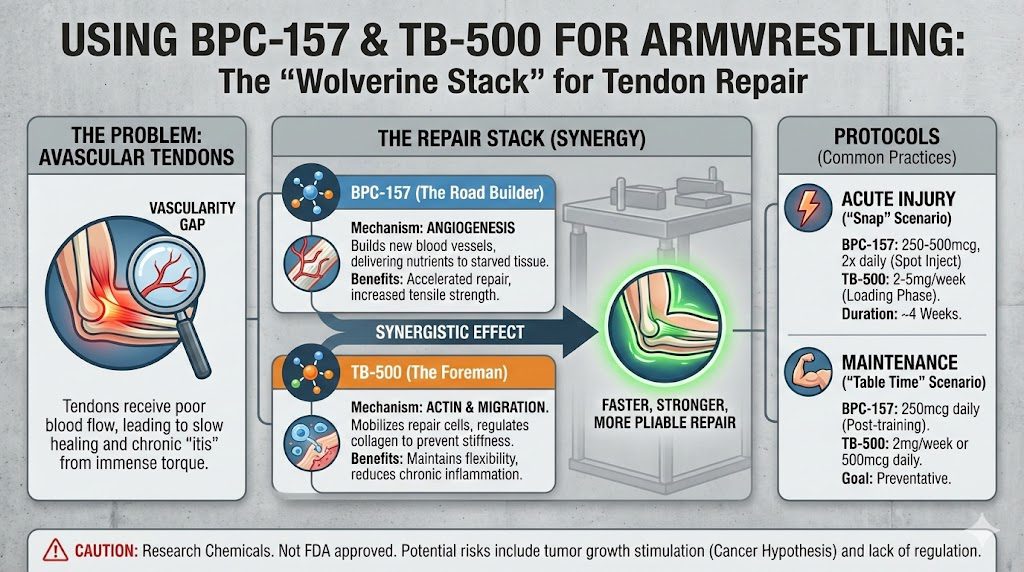
The “Vascularity Gap”: Muscles are highly vascular; they are full of blood. If you tear a muscle belly, it heals quickly because it has a highway of nutrients delivered to it. Tendons and ligaments are avascular (white tissue). They receive very little blood flow. This is why a strained bicep heals in two weeks, but “Golfer’s Elbow” (tendonitis) can plague an armwrestler for two years. The nutrients simply cannot get to the crash site.
This is where the “Wolverine Stack” enters the equation. It is not about building muscle; it is about bridging the vascularity gap.
Component 1: BPC-157 (The Road Builder)
Body Protection Compound-157 is a peptide derived from a protein found in human gastric juice. While it is famous for healing gut issues (like ulcers), its primary application in sports is angiogenesis.
Mechanism for Armwrestling: BPC-157 triggers the formation of new blood vessels (capillaries) from existing ones. For an armwrestler with chronic medial epicondylitis, the tendon is often degenerating because it is starving for oxygen and repair factors. BPC-157 theoretically “builds a road” into that avascular tissue.
Specific Benefits for the Puller:
- Accelerated Tendon Repair: By increasing blood flow to the connective tissue, BPC-157 allows the distal bicep and elbow ligaments to heal at a rate comparable to muscle tissue.
- Increased Collagen Synthesis: It promotes the production of collagen, specifically organizing it in a way that restores tensile strength. This is critical for the “side pressure” integrity of the elbow.
- Neuro-Protection: Armwrestlers often suffer from nerve entrapment (ulnar nerve issues). Some research suggests BPC-157 has neuroprotective properties that can heal damaged nerve endings, reducing the numbness and tingling often felt after a hard practice.
The “Local” Debate: There is a debate in the community about systemic vs. local injection. For BPC-157, the consensus among athletes is that proximity matters.
- Protocol: Armwrestlers often inject BPC-157 subcutaneously as close to the injury as possible. If the pain is in the inner elbow (medial epicondyle), the injection is done in the skin directly above it. The theory is that while the peptide eventually goes systemic, the high local concentration immediately post-injection offers a stronger angiogenic effect at the site of damage.
Component 2: TB-500 (The Foreman)
TB-500 is the synthetic version of Thymosin Beta-4, a naturally occurring protein involved in cell structure and motility. While BPC-157 focuses on blood flow, TB-500 focuses on flexibility and cell migration.
Mechanism for Armwrestling: TB-500 is an actin-sequestering peptide. It upregulates the amount of actin available in the body.
- Cell Migration: It acts as a chemical signal telling repair cells to move from surrounding tissue or bone marrow to the injury site.
- Anti-Inflammatory: It potently reduces chronic inflammation, which is the hallmark of overtraining in armwrestling.
Specific Benefits for the Puller:
- Preventing the “Stiff Arm”: Veteran armwrestlers often cannot fully straighten their arm due to fibrosis and scar tissue buildup. TB-500 helps regulate collagen deposition and keeps healed tissue pliable.
- Muscle Recovery: TB-500 accelerates recovery in muscles like the brachialis and pronator teres that are heavily stressed during hooks and table practice.
Systemic Nature: Unlike BPC-157, TB-500 is widely considered fully systemic. It does not need to be injected near the elbow; a subcutaneous injection in the abdomen will circulate to the injured tissue.
The Synergy: Why Stack Them?
In the armwrestling community, these two are rarely used in isolation. They are viewed as two halves of a whole repair system.
- BPC-157 provides the supply line (angiogenesis and blood vessel formation).
- TB-500 provides the workers and materials (cell migration and tissue remodeling).
The “Cycle” Context: Armwrestling creates intense isometric torsion in the elbow joint. If an athlete is running anabolic steroids, muscles can grow stronger faster than tendons adapt. This is the “danger zone” where muscle strength can exceed connective tissue tolerance. The BPC/TB stack is often used alongside androgen cycles to help connective tissue keep pace with muscular strength gains.
Protocols: How Armwrestlers Use It
Note: This section reflects common practices in athletic communities and is not medical advice.
Usage typically falls into two categories: Acute Repair and Maintenance.
1. Acute Injury Protocol (The “Snap” Scenario)
- BPC-157: 250mcg–500mcg twice daily, usually injected subcutaneously near the injury site.
- TB-500: 2mg–5mg per week split into two doses during a loading phase lasting 4–6 weeks.
- Duration: Usually run for about four weeks or until acute pain subsides.
2. Maintenance / Prevention Protocol (The “Table Time” Scenario)
- BPC-157: 250mcg once daily.
- TB-500: 2mg weekly or 500mcg daily.
- Goal: Reduce inflammation and maintain blood flow to the elbows during heavy training periods.
The Risks and Reality Check
1. The Cancer Hypothesis: The same mechanisms that promote healing—angiogenesis and cell migration—are also associated with cancer growth.
- Angiogenesis: Increased blood vessel formation could theoretically accelerate growth of an undiagnosed tumor.
- Migration: Increased cell mobility could theoretically aid metastasis.
2. The “False Confidence” Trap: Because BPC-157 may reduce pain signals, athletes might return to training too early. Pain relief does not equal structural healing; connective tissue still requires weeks or months to fully repair.
3. Quality Control: These substances are typically sold as research chemicals rather than pharmaceuticals, meaning regulation is minimal and purity can vary significantly between suppliers.
Conclusion: The Future of “Iron Elbows”
In armwrestling, joint durability has always been the limiting factor. No matter how strong the muscle becomes, if the elbow fails, performance collapses.
BPC-157 and TB-500 represent a new approach to recovery in the sport. By increasing vascularization and mobilizing repair cells, these peptides may help athletes train harder and recover faster.
However, they are not miracle cures. They cannot replace proper technique, smart training, and biological healing time. Used responsibly, they may be valuable tools—but like any powerful intervention, they require caution and respect for the body’s limits.


Leave a comment
Your email address will not be published. Required fields are marked *
You must be logged in to post a comment.