
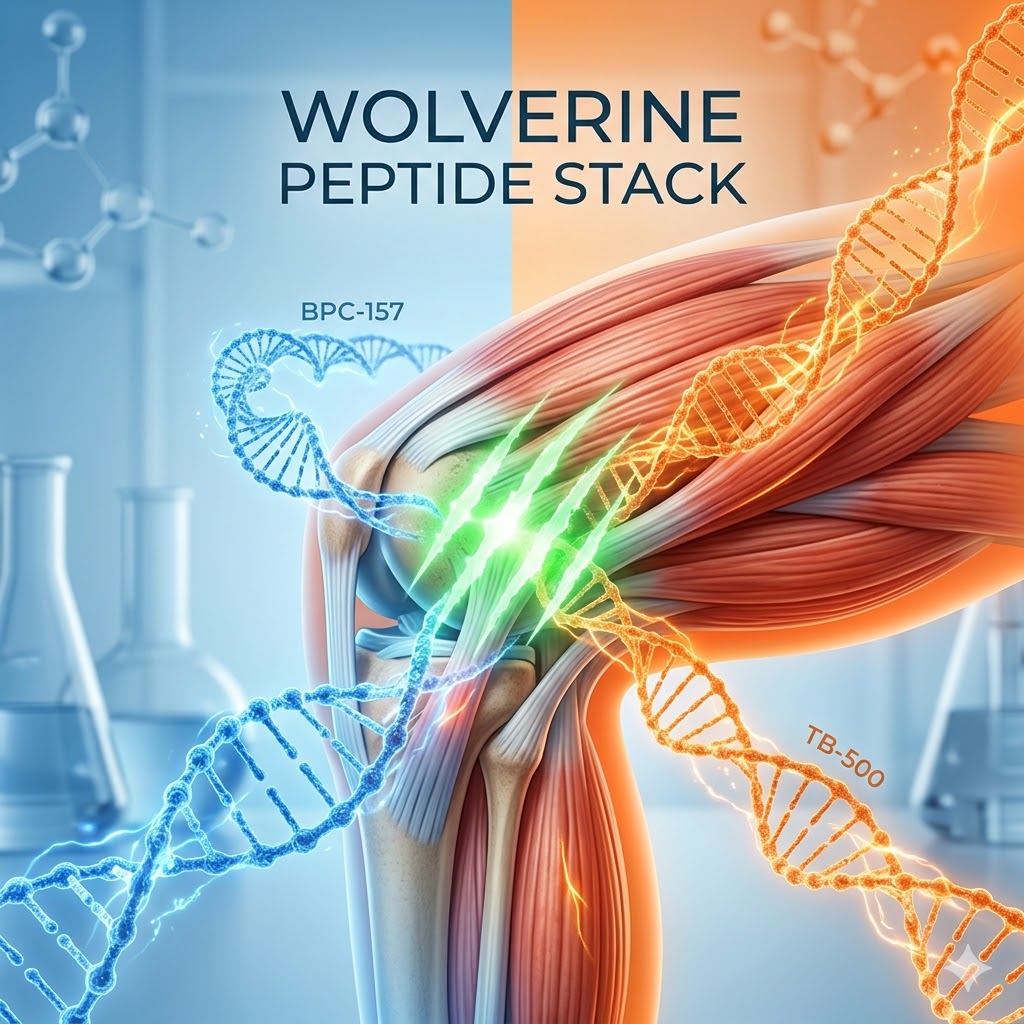
How to use the Wolverine Peptide Stack: A Comprehensive Guide to Healing and Regeneration
Performance optimization and systemic repair are cornerstones for individuals engaged in advanced research, high-level athletics, or simply seeking to enhance their body’s inherent healing capabilities. As recovery barriers often limit progress and well-being, the “Wolverine Peptide Stack”—a combination of the potent regenerative peptides BPC-157 and TB-500—has emerged as a compelling area of study.
Named for its perceived dramatic regenerative properties, this combination aims to accelerate tissue healing, reduce recovery limitations, and promote overall regeneration. This article serves as a strictly informational guide on how to use this powerful peptide combination effectively for advanced research purposes.

Wolverine Peptide Stack
Understanding the Components
To truly grasp how to use the Wolverine Stack effectively, it is essential to first understand the individual peptides that comprise it.
BPC-157: The Targeted Healer
BPC-157 (Body Protection Compound 157) is a pentadecapeptide composed of 15 amino acids, initially discovered as a protective protein within human gastric juice.
Mechanism of Action: It upregulates several crucial growth factors and improves blood flow to injured tissues by stimulating angiogenesis (the formation of new blood vessels) and increasing collagen synthesis.
Primary Use: It is considered a targeted healer, demonstrating significant efficacy in promoting the repair of specific localized tissues, including tendons, ligaments, muscles, bones, nerves, and the gut lining.
TB-500: The Systemic Regenerator
TB-500 is a synthetic version of the naturally occurring peptide Thymosin Beta-4 (Tβ4), which is present in almost all human and animal cells.
Mechanism of Action: TB-500 exerts a potent systemic action, promoting cell migration to the site of injury and fostering angiogenesis. It also possesses significant anti-inflammatory properties, reducing potential scar tissue formation.
Primary Use: Unlike the localized focus of BPC-157, TB-500 influences tissue repair and regeneration across the entire body, making it highly effective for widespread muscle tears, joint issues, and systemic inflammation.
The Power of the Stack: Synergistic Effects
The concept behind combining BPC-157 and TB-500 lies in their distinct, yet complementary, modes of action. While BPC-157 offers targeted healing through improved localized blood supply and collagen support, TB-500 provides systemic regeneration by reducing total-body inflammation and mobilizing cellular “workers” to the damaged tissue.
When run concurrently, research suggests a highly comprehensive recovery process:
BPC-157 creates the necessary local infrastructure (vascularity and collagen scaffolding).
TB-500 sends in the regenerative cells and suppresses systemic inflammation.
This synergy aims to address both the localized tear and the underlying systemic stress, potentially offering optimal results in a much shorter timeframe.
Reconstitution and Dosing Guide
Disclaimer: The information provided here is strictly for educational purposes, referencing commonly discussed protocols in advanced research communities. Peptides are research chemicals, not approved medical treatments. Always consult a qualified healthcare professional before beginning any peptide regimen.
Peptide Reconstitution Steps
Peptides typically arrive in lyophilized (freeze-dried) powder form. They must be reconstituted in Bacteriostatic Water (BAC) to remain stable and sterile.
Prep: Gently wipe the tops of both the peptide vial and the BAC water vial with an alcohol swab.
Draw: Use a sterile syringe to draw the specified amount of BAC water.
Mix: Slowly and gently add the BAC water to the peptide vial, letting it run down the side of the glass. Do not shoot the water directly onto the powder, and never shake the vial violently.
Dissolve: Allow the peptide to dissolve completely, either on its own or through very gentle swirling.
Store: Reconstituted peptides must be stored in the refrigerator when not in use.
Conceptual Dosing Considerations
There is no one-size-fits-all approach. A cautious “low and slow” strategy is generally advised in the research community.
1. BPC-157 Dosing Protocols (Daily Admin)
Range: 250mcg to 500mcg per injection.
Frequency: 1 to 2 times daily (e.g., total 500mcg daily).
Application: Administered near the site of injury or systemically.
Cycle: Typically run for 4 to 8 weeks, followed by a break.
2. TB-500 Dosing Protocols (Weekly Admin) TB-500 utilizes a loading phase followed by a maintenance phase due to its longer systemic action.
Loading Phase (First 2-4 weeks): 2.5mg to 5mg weekly, split into 2 or 3 injections (e.g., 2.5mg twice weekly).
Maintenance Phase (Subsequent weeks): Dropping down to 2.5mg once weekly.
Cycle: Typically run for 4 to 12 weeks.
3. Integration Example (The Wolverine Stack)
BPC-157: 250mcg twice daily, every day.
TB-500: 2.5mg twice weekly for a 4-week loading phase, followed by 2.5mg once weekly for maintenance.
Total duration: 8 to 10 weeks, followed by an off-cycle.
Administration and Logistics
Both BPC-157 and TB-500 are primarily administered via Subcutaneous (SubQ) injections into fatty tissue.
Tools Needed: Small insulin syringes (e.g., 29G-31G), alcohol prep pads, bacteriostatic water, and proper refrigerated storage.
Location: Subcutaneous injections into the abdomen or upper thighs are generally considered safe, relatively painless, and capable of delivering peptides systemically.
Best Practices: Always rotate injection sites and adhere strictly to aseptic (sterile) techniques to prevent site infections.

how to use the wolverine stack
Important Considerations and Potential Risks
Disclaimer: Detailed information about the long-term safety of research peptides is limited. The following observations are based on community reporting and ongoing research.
Side Effects: While often reported as well-tolerated, side effects can include temporary skin irritation at the injection site, mild lethargy, or a brief head rush.
Quality and Sourcing: Obtaining high-purity, research-grade peptide compounds from reputable, lab-tested suppliers is critical. Unverified black-market products pose significant risks, including contamination or incorrect dosing. Ensure your supplier provides verifiable, third-party lab testing.
Integrative Approach: Peptides are not magical cures. They are most effective when utilized as tools within a comprehensive approach that includes a nutritious diet, adequate hydration, sufficient sleep, and proper physical rehabilitation protocols.
Conclusion
The Wolverine Peptide Stack offers profound potential for accelerating recovery, enhancing tissue repair, and optimizing physiological regeneration. By understanding the distinct mechanisms of BPC-157’s localized vascular infrastructure and TB-500’s systemic cellular mobilization, researchers can approach tissue repair strategically. Always prioritize meticulous reconstitution, strict sterile administration, high-quality lab-tested sourcing, and professional medical consultation when exploring these advanced performance optimization tools.



Leave a comment
Your email address will not be published. Required fields are marked *
You must be logged in to post a comment.