
In the advanced study of sports pharmacology and performance endocrinology, understanding how different compounds interact is the dividing line between optimal physiological enhancement and biological chaos. Often, researchers and athletes attempt to pair compounds based on fundamental assumptions—assuming that if Drug A causes a specific side effect, Drug B, which treats that side effect, must be the logical countermeasure.
Perhaps nowhere is this misunderstanding more prevalent—and potentially harmful—than in the combined use of Anadrol (Oxymetholone) and Aromasin (Exemestane).
While searching for “Anadrol vs. Aromasin” might imply a comparison of similar compounds, comparing these two drugs is a category error. Anadrol is a powerful, highly toxic anabolic-androgenic steroid (AAS) designed to build massive amounts of tissue. Aromasin is an ancillary drug—specifically, an aromatase inhibitor (AI)—designed to control estrogen.
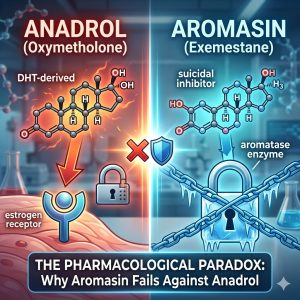
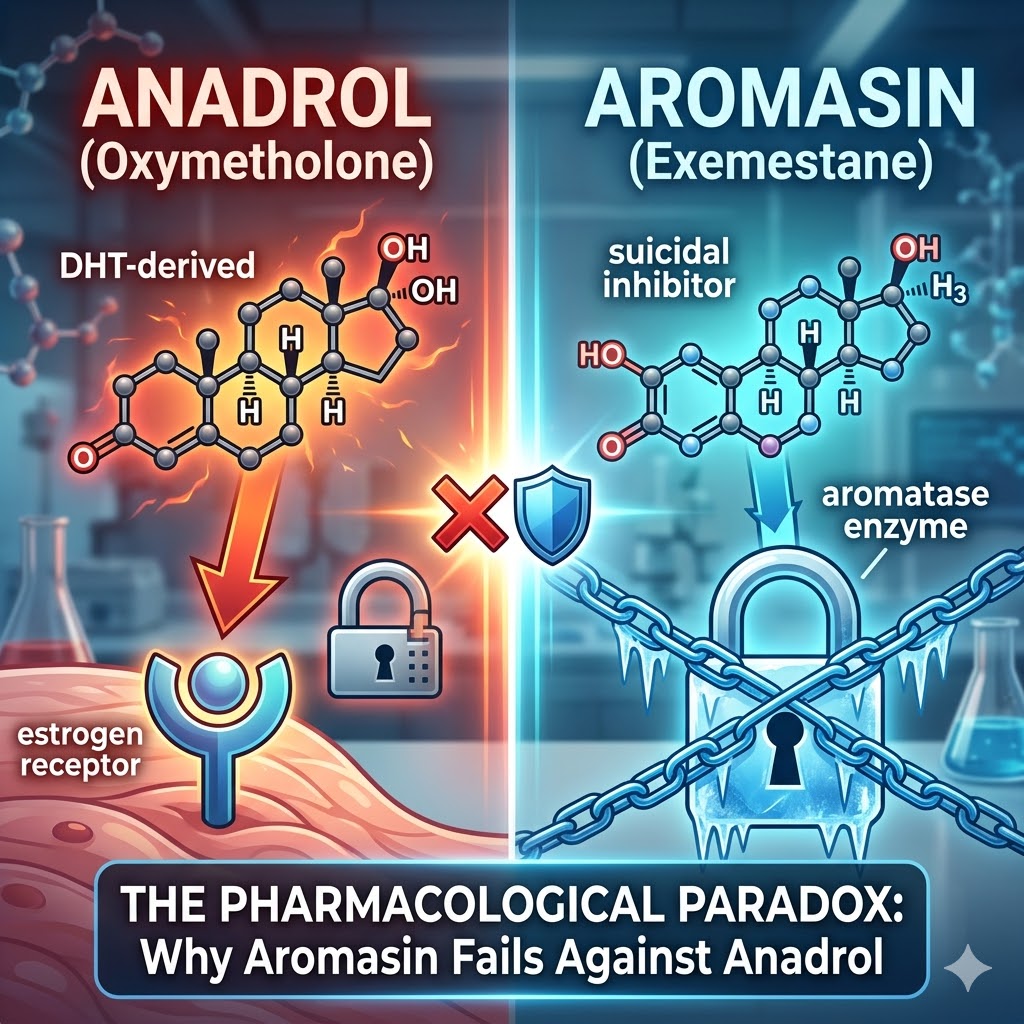
The true educational value of exploring these two compounds together lies in a notorious biochemical paradox: Why Aromasin is entirely useless at stopping the severe estrogenic side effects of Anadrol.
This comprehensive guide breaks down the independent mechanics of both drugs, the science behind the aromatase enzyme, and why attempting to use Aromasin to mitigate Anadrol’s side effects is a fundamental misunderstanding of human endocrinology.
Disclaimer: The following article is strictly for informational and educational purposes. The compounds discussed are powerful prescription medications and research chemicals. This information does not constitute medical advice, nor does it endorse the illicit use of controlled substances.
To understand the conflict between these two compounds, we must first isolate their individual mechanisms of action.
Anadrol (chemical name Oxymetholone) was developed in the 1960s primarily to treat severe anemia and muscle-wasting diseases. Because red blood cells carry oxygen to muscle tissue, a lack of red blood cells results in lethargy and weakness. Anadrol triggers a massive release of erythropoietin (EPO), pushing red blood cell production into overdrive.
In performance and bodybuilding contexts, Anadrol is classified as a “wet” mass builder. It is renowned for rapid, explosive weight gain, delivering massive surges in absolute strength and intracellular water retention. Users frequently report gaining 10 to 15 pounds in a matter of weeks.
Biochemically, Anadrol is a derivative of Dihydrotestosterone (DHT). It has been modified with an added 2-hydroxymethylene group, which dramatically increases its anabolic power, and it is 17-alpha-alkylated (C17-aa), allowing it to survive oral ingestion and pass through the liver.
This structural origin is where the confusion begins. In the human body, DHT cannot aromatize (convert) into estrogen. Because Anadrol is a DHT derivative, it inherently lacks the chemical structure required to interact with the aromatase enzyme. It is mathematically and biologically impossible for Anadrol to convert into circulating estradiol.
Yet, Anadrol is notorious for causing some of the most severe “estrogenic” side effects of any steroid in existence, including massive water retention, blood pressure spikes, and rapid-onset gynecomastia (the growth of male breast tissue).
If it doesn’t convert to estrogen, why does it act like estrogen? Researchers theorize two mechanisms:
Direct Receptor Activation: Anadrol, or its metabolites, may directly bind to and activate the estrogen receptor in tissue, bypassing the need to convert into estrogen first.
Progestational Activity: While studies show Anadrol has low affinity for the progesterone receptor, some researchers believe it acts synergistically with circulating estrogen, amplifying its effects.
Now, we look at the ancillary compound often mistakenly deployed to fix the Anadrol paradox.
Aromasin (Exemestane) was developed as an adjuvant treatment for estrogen-receptor-positive breast cancer in postmenopausal women. Certain breast cancers feed heavily on estrogen to grow. By eliminating the estrogen in the body, Aromasin effectively starves the tumor.
In the realm of performance enhancement, when athletes inject supraphysiological amounts of Testosterone (or other aromatizing compounds like Dianabol), the body attempts to maintain homeostasis. It takes the excess testosterone and forces it through the aromatase enzyme, converting it into estrogen. Aromasin is used to halt this process.
Aromatase Inhibitors are divided into two categories: Type II (non-steroidal) like Arimidex, and Type I (steroidal) like Aromasin.
Aromasin is a Type I “suicidal” inhibitor.
When a drug like Arimidex binds to the aromatase enzyme, it only does so temporarily. If you stop taking Arimidex, the enzymes are freed, leading to a massive “estrogen rebound.”
Aromasin, conversely, is structurally similar to androgens. The aromatase enzyme grabs the Aromasin molecule, attempting to convert it. In doing so, the Aromasin permanently bonds to the enzyme, disabling and destroying it. The enzyme commits “suicide.”
Estrogen levels cannot rise again until the body literally manufactures brand new aromatase enzymes, which takes days or weeks. This makes Aromasin incredibly powerful, highly effective, and relatively forgiving regarding estrogen rebound.
We now arrive at the intersection of the two compounds and the core of the informational thesis: Taking Aromasin to cure Anadrol-induced gynecomastia or water retention is a futile and dangerous practice.
To understand why, visualize a lock and a key.
The Aromatase Enzyme is a lock.
Testosterone is a key that fits into the lock, turns, and comes out the other side as Estrogen.
Aromasin is glue. You squirt it into the lock, permanently jamming it so no more keys can enter.
If an athlete runs a cycle of Testosterone and begins to develop itchy nipples (the onset of gynecomastia), they introduce Aromasin. The Aromasin jams the lock (destroys the enzyme), stopping the conversion of testosterone to estrogen. The estrogen levels drop, and the gynecomastia subsides. The protocol works flawlessly.
However, Anadrol does not use the lock.
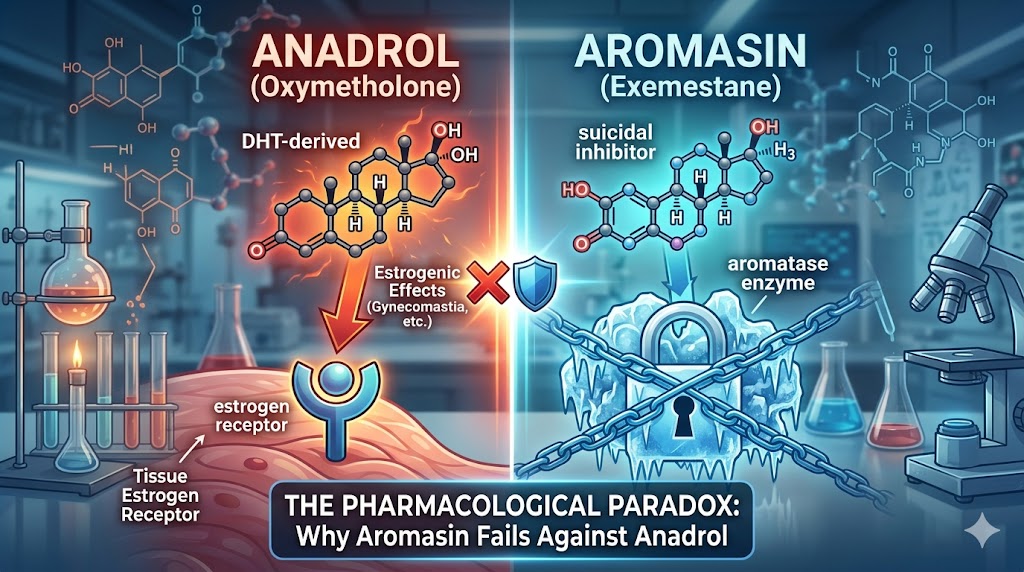
Because Anadrol is a DHT derivative, it does not interact with the aromatase enzyme. It causes gynecomastia and water retention through direct activation at the receptor site in the breast tissue or through alternative progestational pathways.
If an athlete takes Anadrol and develops gynecomastia, and they respond by taking Aromasin, the Aromasin will successfully destroy the aromatase enzymes in the body. But this achieves absolutely nothing regarding the Anadrol. The Anadrol continues directly bombarding the breast tissue receptors, entirely unimpeded by the lack of aromatase enzymes.
The scenario described above is not just ineffective; it is actively destructive.
Oral steroids like Anadrol are never run in isolation; they are run alongside an injectable Testosterone base. The testosterone is necessary for normal physiological function, libido, and neuroprotection.
If a user takes Aromasin to combat Anadrol side effects, the Aromasin will target the only thing it can target: the estrogen converting from the Testosterone base. The user will rapidly drive their circulating estradiol levels to near zero (crashing their estrogen).
Estrogen is highly cardioprotective, vital for lipid management, and essential for joint lubrication. An athlete who makes this pharmacological error will find themselves in a worst-case scenario:
They will still have gynecomastia and high blood pressure from the Anadrol.
They will simultaneously suffer from crashed estrogen, resulting in severely painful, dry joints, lethargy, destroyed HDL cholesterol levels, and a complete loss of libido.
They will have subjected their body to a harsh chemical for zero benefit, multiplying their side effects rather than resolving them.
If an aromatase inhibitor like Aromasin is pharmacologically useless against the estrogenic side effects of Anadrol, how do clinical researchers and advanced athletes manage the compound?
The answer lies in targeting the receptor, rather than the enzyme.
Instead of trying to stop the creation of estrogen (which Anadrol circumvents anyway), the solution is to block the receptor where the Anadrol is binding. This is achieved using SERMs, most notably Nolvadex (Tamoxifen) or Raloxifene.
SERMs work by competing for the estrogen receptor. When Tamoxifen is introduced, it travels to the breast tissue and securely locks itself into the estrogen receptors. However, unlike estrogen or Anadrol, the Tamoxifen molecule does not activate the receptor. It acts as a shield.
When the Anadrol attempts to bind to the breast tissue to cause gynecomastia, it finds the receptor already occupied by Tamoxifen. The Anadrol is repelled, and the gynecomastia is halted.
Aromasin attempts to stop the factory from making estrogen (Useless against Anadrol).
Nolvadex puts up a shield over the target tissue (Highly effective against Anadrol).
It is also vital to note that Anadrol’s side effects extend far beyond the estrogen receptor. Because it is a C17-aa oral compound, it is notoriously hepatotoxic (toxic to the liver). It causes significant elevations in liver enzymes (AST/ALT) and heavily skews the lipid profile, driving bad cholesterol (LDL) up and good cholesterol (HDL) down.
While SERMs can protect the breast tissue, they do nothing for the internal organs. Protocols utilizing Anadrol strictly require robust organ support:
TUDCA (Tauroursodeoxycholic acid): A water-soluble bile acid that is highly effective at clearing liver bile and protecting hepatic cells from toxic stress.
NAC (N-Acetyl Cysteine): A precursor to glutathione, the body’s most powerful master antioxidant, crucial for liver detoxification.
Hydration and Cardio: Rigorous cardiovascular protocols and deep hydration (4+ liters of water daily) are required to offset the extreme blood pressure spikes associated with Anadrol’s intracellular water retention.
The juxtaposition of Anadrol and Aromasin serves as a vital lesson in the science of performance endocrinology. Biochemistry does not operate on assumptions.
Aromasin is an elite, highly effective Type I suicidal inhibitor, perfect for managing the aromatization of compounds like Testosterone, Dianabol, and Equipoise. It protects the physique by managing circulating estradiol at the enzymatic level.
Anadrol is a volatile, incredibly powerful DHT derivative that builds massive amounts of tissue while bypassing standard enzymatic pathways to exert its side effects.
Understanding that these two compounds operate on entirely separate, non-intersecting biological tracks is crucial. Utilizing the wrong ancillary drug does not just fail to solve the problem; it creates entirely new, highly damaging physiological states. In the world of advanced research and physical enhancement, chemical literacy is the only viable defense mechanism.