


100% Secure Checkout Secure
Third-Party HPLC Tested HPLC Tested

What Does TB-500 Do To Your Body?

In the world of regenerative medicine and high-performance athletics, TB-500 has earned a mythical status. Often referred to as the “Wolverine drug,” it is prized for its ability to accelerate recovery from injuries that would otherwise be career-ending. But stripped of the gym-floor hype, what exactly does this peptide do to human physiology?

TB-500 is a synthetic fraction of the naturally occurring protein Thymosin Beta-4 (TB4). Unlike anabolic steroids, which force muscle cells to grow larger through hormonal signaling, TB-500 operates on a microscopic, structural level. It fundamentally alters how your body manages its own “repair crew,” influencing everything from blood vessel formation to how cells move through tissue.
This article explores the specific physiological mechanisms of TB-500, detailing how it interacts with your body to facilitate rapid repair and the biological risks involved.

1. The Primary Mechanism: Actin Sequestration

To understand what TB-500 does to your body, you must first understand actin.

Actin is a protein that makes up the cytoskeleton—the internal scaffolding that gives cells their shape and structure. It is vital for cell movement (motility) and division. In a healthy body, actin exists in two states: “free” monomers (G-actin) and polymerized filaments (F-actin).

Image of actin filament polymerization
Actin filament polymerization

The Physiological Impact: TB-500 functions as a major actin-sequestering molecule. When you inject it, it binds to free actin monomers and acts as a reservoir.

  • The Buffer: It prevents actin from polymerizing prematurely, creating a massive stockpile of “raw materials” for cell construction.
  • The Release: When tissue is damaged, TB-500 releases this stored actin directly to the injury site.

Imagine a construction site where the workers usually have to wait for bricks to be manufactured one by one. TB-500 essentially delivers a pallet of 10,000 bricks directly to the site. This availability allows cells to rebuild their structure and close wounds at a speed that is significantly faster than the body’s natural baseline.

2. Angiogenesis: Growing New Blood Vessels

One of the most profound physical changes TB-500 induces in the body is angiogenesis—the growth of new blood capillaries from existing vessels.

This is particularly critical for avascular tissues like tendons and ligaments (e.g., the rotator cuff, Achilles tendon, or patellar tendon). These white tissues naturally have very poor blood supply, which is why tendonitis can linger for months or years. They simply cannot get the nutrients required to heal.

How TB-500 Changes This: By upregulating Vascular Endothelial Growth Factor (VEGF), TB-500 signals endothelial cells (the lining of blood vessels) to proliferate.

  • Vascularization: Over a cycle of 4-6 weeks, new microscopic capillaries begin to form around the injury site.
  • Nutrient Delivery: This increased vascular density floods the injured area with oxygen, amino acids, and repair factors, effectively turning a “slow-healing” zone into a metabolically active one.

3. Cellular Migration: Mobilizing the Workforce

Healing is a logistical challenge. For a tear to mend, healthy cells must physically move from the surrounding tissue into the gap of the injury. This process is called chemotaxis.

TB-500 acts as a powerful chemoattractant. It changes the chemical signaling environment of your body to make cells more mobile.

  • Keratinocytes: It signals skin cells to migrate faster, closing surface wounds and surgical incisions rapidly.
  • Stem Cells: Research suggests TB-500 can mobilize progenitor cells from the bone marrow, directing them to navigate through the bloodstream to the site of trauma.

In simple terms, TB-500 doesn’t just provide the materials (actin); it also shouts through a megaphone, telling the body’s repair cells exactly where to go and helping them get there faster.

4. Reducing Scar Tissue (Anti-Fibrotic Action)

When the body heals a muscle tear naturally, it often does a “rush job.” Instead of laying down organized muscle fibers, it deposits Type III Collagen—a disorganized, stiff web we know as scar tissue. This scar tissue is weaker than the original muscle and prone to re-injury.

The Physiological Shift: TB-500 modulates inflammation by downregulating specific cytokines (like TGF-beta) that trigger fibrosis.

  • Organized Repair: It encourages the deposition of Type I Collagen in a linear, parallel fashion.
  • Pliability: The result is healed tissue that is flexible and functional, rather than a stiff knot. Users often report that old injuries feel “looser” and less restricted after a cycle.

5. Systemic Effects: Beyond the Injection Site

A common misconception is that TB-500 works locally—that you must inject it directly into the injured shoulder or knee. Physiologically, this is incorrect.

TB-500 is a low molecular weight peptide. Once injected subcutaneously (usually into belly fat), it enters the bloodstream and becomes systemic. It circulates through the entire body, but it only “activates” where it finds damaged tissue signals.

  • Whole-Body Repair: This means a single injection can simultaneously work on a torn pec, a strained hamstring, and gum inflammation. It is a non-discriminatory repair signal.

6. The Risks: The “Cancer Hypothesis”

The physiological power of TB-500 is not without significant risk. The exact mechanisms that make it a miracle for healing—angiogenesis, cell migration, and cell survival—are the same mechanisms utilized by cancer.

  • The Theory: While there is no evidence that TB-500 causes cancer (it is not a mutagen), it could theoretically act as “fertilizer” for an existing tumor.
  • The Mechanism: If you have an undiagnosed micro-tumor, the increased blood vessel growth (angiogenesis) provided by TB-500 could allow that tumor to grow rapidly. Furthermore, the enhanced cell migration could theoretically assist cancer cells in spreading (metastasis) to other parts of the body.

For this reason, TB-500 is considered a high-risk compound for anyone with a history of cancer or those who have not had recent cancer screenings.

Infographic titled What Does TB-500 Do To Your Body detailing mechanisms and risks
A visual breakdown of the four primary regenerative mechanisms of Thymosin Beta-4 and the critical safety considerations regarding tumor growth.

Conclusion

So, what does TB-500 do to your body? It effectively places your system into a state of hyper-recovery. By saturating cells with actin, forcing the growth of new blood vessels, and directing repair cells to move efficiently, it bypasses the body’s natural “speed limits” on healing.

However, this biological override comes with the responsibility of understanding that “growth” is not always positive. The same pathways that repair a tendon can potentially feed a tumor. As a research chemical, TB-500 offers a glimpse into the future of medicine, but currently, it remains an experimental tool with a powerful—and double-edged—physiological impact.

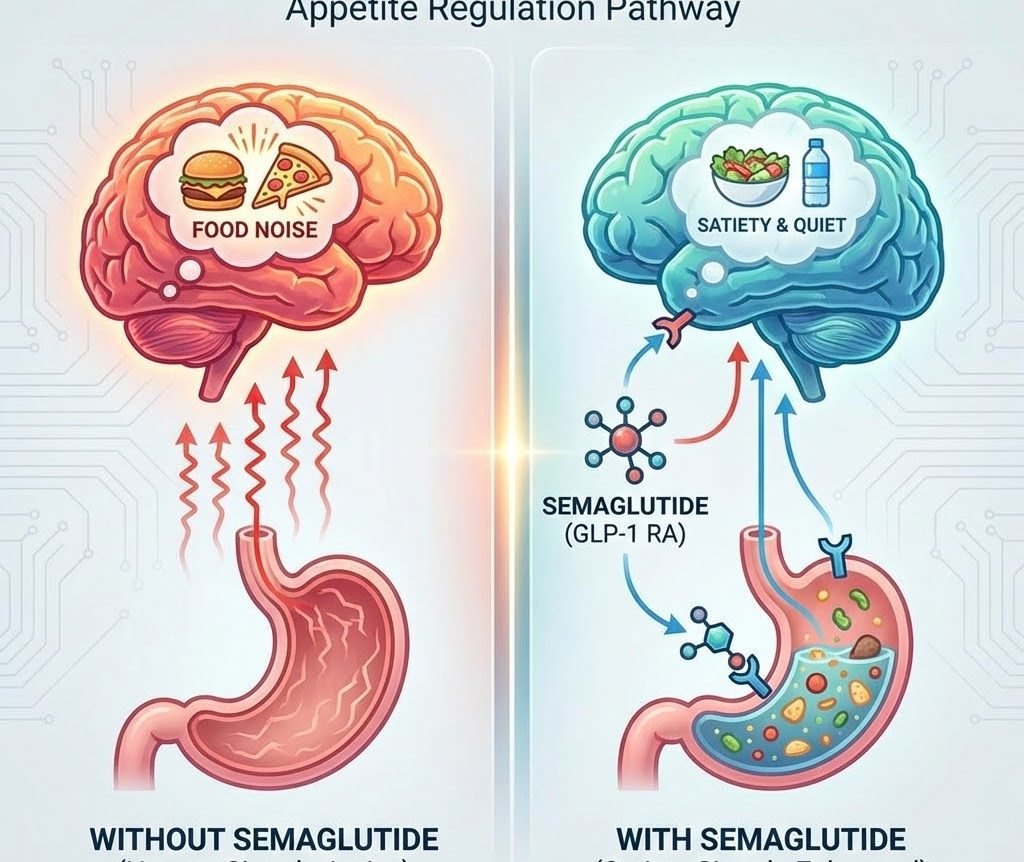
: Split-screen illustration titled "The Semaglutide Effect" comparing a brain experiencing "Food Noise" and hunger signals on the left against a brain experiencing "Satiety & Quiet" on the right due to GLP-1 receptor activation.

How does Semaglutide help you lose weight?

In the last few years, the landscape of weight loss has shifted seismic plates. For decades, the prevailing advice was a variation of “eat less, move more”—a model that framed obesity almost exclusively as a failure of willpower. But the meteoric rise of Semaglutide (sold under brand names like Ozempic, Wegovy, and Rybelsus) has fundamentally changed that conversation.

It is no longer just about calories in versus calories out; it is about hormones, signaling pathways, and the biological architecture of hunger.

Semaglutide is not a stimulant, a fat burner, or a diuretic. It is a peptide that hacks the body’s own satiety system. But how exactly does a weekly injection cause people to lose 15% to 20% of their body weight? The answer lies in a complex interplay between the gut, the brain, and the pancreas.

Infographic explaining how Semaglutide rewires metabolism for weight loss
A step-by-step visual guide explaining the four key biological mechanisms by which Semaglutide promotes sustainable weight loss.

1. The Biological Mimic: Understanding GLP-1

To understand Semaglutide, you have to understand the hormone it copies: Glucagon-Like Peptide-1 (GLP-1).

Under normal conditions, when you eat a meal, your intestines release a cascade of hormones. One of the most important is GLP-1. This hormone travels through the bloodstream and acts as a biological messenger, delivering a “fed state” signal to various organs. It tells the pancreas to release insulin, tells the liver to stop dumping sugar into the blood, and tells the brain that you have had enough to eat.

The Problem with Nature: Natural GLP-1 is incredibly short-lived. It has a half-life of only 1 to 2 minutes before it is broken down by an enzyme called DPP-4. It provides a brief signal of fullness, and then it vanishes.

The Semaglutide Solution: Semaglutide is a synthetic agonist (mimic) of GLP-1. However, it has been chemically modified to survive the DPP-4 enzyme. Instead of lasting two minutes, Semaglutide has a half-life of approximately one week. This means that once injected, it keeps the body in a state of heightened “fullness signaling” 24 hours a day, 7 days a week, rather than just for a few minutes after a meal.

2. Mechanism I: The Hypothalamus (The Hunger Switch)

The most profound effect of Semaglutide occurs in the brain. The drug crosses the blood-brain barrier and binds to GLP-1 receptors in the hypothalamus, the control center for appetite and metabolism.

Within the hypothalamus, there are two primary sets of neurons that regulate weight:

  • POMC Neurons: These are the “brake pedal.” When activated, they suppress appetite and increase energy expenditure.
  • AgRP Neurons: These are the “gas pedal.” When activated, they trigger intense hunger and food-seeking behavior.

Semaglutide essentially keeps its foot on the brake. By stimulating the POMC neurons and inhibiting the AgRP neurons, it drastically lowers the body’s “hunger baseline.” Users often report forgetting to eat or feeling satisfied after consuming portions that are half the size of what they previously ate. It physically limits the desire for food before the first bite is even taken.

3. Mechanism II: Delayed Gastric Emptying

While the brain effect reduces the desire to eat, the gastric effect reduces the ability to overeat.

GLP-1 receptors are highly concentrated in the stomach. When Semaglutide binds to these receptors, it slows down gastric motility—the muscular contractions that push food from the stomach into the small intestine.

Normally, the stomach might empty a meal in 1 to 2 hours. On Semaglutide, this process is significantly decelerated. Because food remains in the stomach for a much longer duration, physical distension is maintained. This sends a prolonged mechanical signal of fullness to the brain via the vagus nerve.

This mechanism is why overeating on Semaglutide can be physically painful. If a user attempts to eat their pre-drug portion sizes, the food has nowhere to go, leading to nausea, bloating, and vomiting.

4. Mechanism III: The “Food Noise” Silencer

Perhaps the most fascinating—and least understood—aspect of Semaglutide is its psychological impact. Many people living with obesity describe a phenomenon known as Food Noise.

What is Food Noise? It is the constant intrusive mental chatter about food: What am I eating for lunch? Is there leftover cake in the breakroom? I shouldn’t have eaten that. When is dinner?

Semaglutide appears to affect the brain’s dopaminergic reward system (the mesolimbic pathway). This is the same pathway involved in addiction. By dampening the dopamine spike associated with palatable foods, Semaglutide turns the volume down on food noise.

Users report that food becomes neutral. A slice of pizza looks like a slice of pizza, not a source of comfort or excitement. This liberation from obsessive food thoughts allows people to make dietary choices based on logic rather than compulsion.

5. Mechanism IV: Metabolic Regulation (Insulin & Glucagon)

While weight loss is the headline, Semaglutide was originally designed for Type 2 Diabetes, and its metabolic effects are critical for fat loss.

  • Insulin Secretion: It stimulates the pancreas to release insulin only when blood sugar is high. Insulin helps usher glucose into cells to be used for energy.
  • Glucagon Suppression: It inhibits the release of glucagon, a hormone that tells the liver to release stored sugar into the bloodstream.

By stabilizing blood sugar levels, Semaglutide prevents the spikes and crashes that often drive sugar cravings. When blood sugar remains stable, energy levels stay consistent and the body is less likely to trigger emergency hunger signals.

6. The Clinical Reality: Results vs. Risks

Semaglutide is not magic; it is a tool that amplifies the effects of a caloric deficit.

The Efficacy Data: In the landmark STEP trials, participants taking 2.4 mg weekly lost an average of 14.9% of their body weight over 68 weeks, compared to just 2.4% in the placebo group.

The Side Effect Profile:

  • GI Distress: Because it slows the stomach, nausea, vomiting, diarrhea, and constipation are common.
  • Muscle Loss (Sarcopenia): Rapid weight loss often includes muscle loss without adequate protein and resistance training.
  • “Ozempic Face”: Rapid facial fat loss can create a gaunt or aged appearance.
Illustration comparing hunger signals versus satiety with Semaglutide
A visual comparison of the brain-gut axis showing how Semaglutide shifts the body from hunger signaling to biological satiety.

7. The “Set Point” Theory and Long-Term Use

The Set Point Theory suggests the body fights to maintain a certain weight range. When you diet, metabolism slows and hunger hormones increase.

Semaglutide appears to lower this set point, convincing the body it is safe to release stored energy without triggering starvation alarms.

The Rebound Trap: However, current data suggests Semaglutide is a treatment rather than a cure. When the drug is discontinued, gastric emptying speeds up and food noise often returns. Many users regain up to two-thirds of lost weight within a year.

Conclusion

Semaglutide helps people lose weight not by burning fat directly but by altering the signals the brain receives about hunger and energy balance. It creates a physiological environment where eating less feels natural rather than forced. By synchronizing the gut and brain, it bridges the gap between biological drive and behavioral intent.

Product has been added to your cart
Compare (0)